
Earthmoving Gowrie Junction QLD 4352
Acreage and semi-rural sites can involve long driveways, drainage crossings and substantial material movement.
Send My Site Details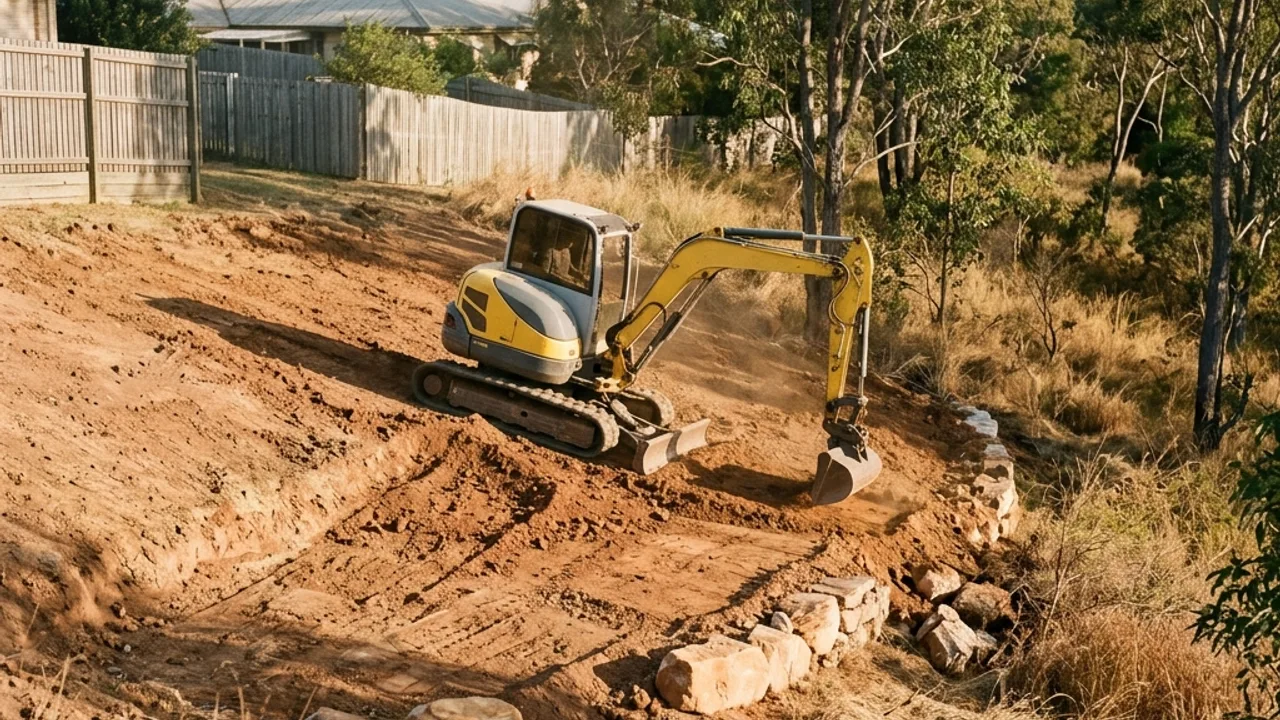
Earthmoving Toowoomba service decisions in Gowrie Junction
A successful Gowrie Junction earthmoving outcome means delivering a precisely formed profile, level, or cleared area, accompanied by clear evidence for the subsequent stages of work. The completion note should explicitly identify achieved levels, detail the disposition of any remaining spoil, and name the party formally accepting the prepared surface, particularly for extensive driveway bases or land shaping. A stop-and-review point should be nominated if excavation exposes unexpected services, weak fill, seepage, or harder ground, ensuring prompt discussion. The written scope must cover mobilisation, necessary attachments, operator time, loading logistics, transport, disposal assumptions, and site protection. If conditions differ from the brief, a named review point ensures owner and contractor discussion before extra work proceeds.
About Gowrie Junction
Gowrie Junction's acreage and semi-rural properties frequently present earthmoving projects involving extensive driveways, significant drainage crossings, and substantial material movement. The scale of these sites often dictates a different logistical approach compared to urban blocks. Landmarks such as the Gowrie Junction Progress Association Hall, Gowrie Creek, and Gowrie Junction State School offer a broad geographic context for project discussions, but detailed on-site surveys are always necessary. Access from Old Homebush Road, Gowrie Junction Road, or Morris Road can involve longer, unsealed tracks; therefore, it is critical to photograph the work zone from both directions, ensuring plant standing room and spoil transfer logistics are fully visible. Understanding neighbouring areas like Cotswold Hills, Charlton, and Kingsthorpe aids in coordinating larger earthmoving operations.
Local excavation context for Gowrie Junction
In Gowrie Junction, larger acreage and semi-rural properties mean that quantity estimates, truck access, and comprehensive erosion control are paramount considerations well before mobilisation. Where the final outcome is contingent on bearing capacity, structural stability, or exact levels, the integration of survey, engineering, or geotechnical information becomes indispensable. Clearly mark all existing structures, utility lines, and any significant vegetation or sensitive areas that must be preserved. The project brief should specify where excavated material can be temporarily stockpiled on the property and whether direct truck loading is practical, which is often a key factor on larger sites. The chosen machinery must be capable of efficiently completing the nominated profile within the measured site boundaries.
Before committing to an earthmoving scope in Gowrie Junction, it’s essential to scrutinise its treatment of design levels, underground services, work zone management, and material handling. Obtain current essential services information and plan for detailed site-specific locating of any private utility connections. It is vital to measure the travel envelope at gates, eaves, trees, and fences, rather than quoting only the entrance width, for all machine movements. Furthermore, given the expansive nature of many sites, nominating a stop-and-review point if excavation exposes unexpected services, weak fill, seepage, or harder ground is crucial. Clarity on these points minimises potential disruptions.
Earthmoving in Gowrie Junction presents a canvas dominated by acreage and semi-rural properties, a stark contrast to the urban confines of Toowoomba City. Here, projects often involve extensive land shaping for new homesteads, significant lengths of driveway construction, or the creation of large-scale drainage solutions. The inherent scale of these sites, often bounded by natural features like Gowrie Creek, means earthmoving operations involve substantial material volumes and longer haul distances. Access routes, while potentially less constrained by neighbours, can be lengthy and unsealed, becoming a critical factor in wet weather. The ground itself might present a mix of agricultural soils, heavier clays, or even intermittent rock, influencing machine selection and excavation methods. Erosion and sediment control (ESC) becomes a paramount consideration, particularly given the proximity to waterways and the potential for large areas of disturbed earth, ensuring environmental integrity across the landscape. Developing a precise earthmoving brief for Gowrie Junction requires a detailed understanding of the property's aspirations and its natural characteristics. The brief should include an accurate quantity takeoff for all proposed cuts and fills, as this directly impacts the scale of machinery and transport required. For long driveways, the required width, subgrade material, and final surface levels must be explicitly stated, along with any necessary drainage culverts or crossings. An ESC plan is an important starting point, detailing measures such as sediment fences, diversion banks, and revegetation strategies to prevent soil loss into natural watercourses like Gowrie Creek. The brief also needs to consider the logistics of truck access, specifying suitable haul roads and any limitations on vehicle weights or dimensions, particularly if existing access points are narrow or require upgrading. Furthermore, if the project involves significant land contouring or the creation of water features, a clear hydrological assessment and design should be incorporated. Given the substantial material movement, identifying suitable on-site reuse areas for excavated soil, such as for landscape mounding, can reduce off-site cartage requirements.
Earthmoving services available in Gowrie Junction
Preparing a useful site brief
For an earthmoving enquiry in Gowrie Junction, a dimensioned sketch, extensive wide and close-up photographs, and clear target depths or levels are indispensable. Include any relevant engineering or design drawings, especially for long driveways or drainage works near Gowrie Creek. Clearly illustrate the access route from Old Homebush Road or the property's primary frontage to the excavation area. The inspection or hold point that occurs before drainage, concrete, landscaping, or building work covers the ground must be clearly recorded. Define the truck positioning, maximum spoil stockpile area, and any existing surfaces needing protection. State whether excavated material is intended for reuse on-site, testing, off-site export, or for later landscaping. Include Gowrie Junction Progress Association Hall, Gowrie Creek, Gowrie Junction State School when they help orient the site notes.